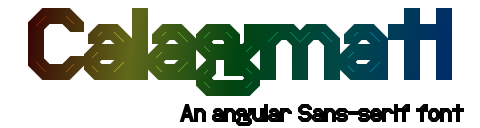
Calagmati is licensed under a CC-BY-ND 4.0 license, making it free to use for both personal and commercial usage. You may also re-distribute the font, provided that you do not alter the file or claim it as your own work.
The Universal Character Set (UCS for short) is divided up into 17 planes, with 65,536 codepoints each. The first plane is the Basic Multilingual Plane (BMP for short, plane 0), which contains a lot of characters that are used in today's living scripts and languages, and supported by every program that supports Unicode. Even in 2026, there are still a handful of programs and operating systems that do not support the other 16 planes.
Calagmati contains numerous scripts (some of these are still used today, but there wasn't enough room in the BMP; some are historical scripts that are no longer in primary use today (speaking of which, there are some historical scripts in the BMP, like Runic, Ogham, Coptic) and characters in the Supplementary Multilingual Plane (SMP for short, plane 1). Whether these are displayed or not depends on the rendering program, your operating system, and any fonts you have installed, as well as the font linking.
For the first test, look at this character:
𝓛In general, it's difficult at first to predict whether these characters will display correctly in software or not. You will have to test that yourself.
Calagmati contains a number of scripts that are written from right-to-left. These scripts are: Hebrew, Phoenician, Hatran, Sidetic, Imperial Aramaic.
To test this support, look at the following samples:
עבריתThe left most characters from top to bottom should be: "ת", "𐤍", "𐣭", "", "𐡕". If not, then your browser does not handle some or all of these scripts correctly.
Calagmati includes a number of OpenType features. This section lists out the features that the font uses. Not every browser supports these.
Calagmati uses three stylistic sets for the single story a and g, and the curled t. It is like that so users can pick and choose which features the user needs.
Normal: Calagmati
Alt. A: Calagmati
Alt. G: Calagmati
Alt. T: Calagmati
All: Calagmati
Calagmati uses .rlig for the Armenian letters with abbreviation mark above, and .ccmp for tone contours and Variation Selectors (the latter is defined via format14 as well).
This character is rarely used if at all with modern Armenian, but old Armenian uses it.
ամ՟The ՟ should be positioned above the մ.
The left characters should be touching the rim, while the right characters should be separate from the rim.
Calagmati mainly uses this feature for Old Italic as some languages that used this script used it going from right-to-left.
Left-to-right: 𐌌𐌄𐌊𐌇 𐌓𐌀𐌔𐌍𐌀𐌋
Right-to-left: 𐌌𐌄𐌊𐌇 𐌓𐌀𐌔𐌍𐌀𐌋
The text on the bottom should be flipped horizontally from the text on the top.
If a version indicator of Calagmati is shown here, then that is the version you have installed. If it shows a version indicator of another font, or another symbol, then it is either likely that: